Dublin High School’s Ron Rubio Brings History to Life
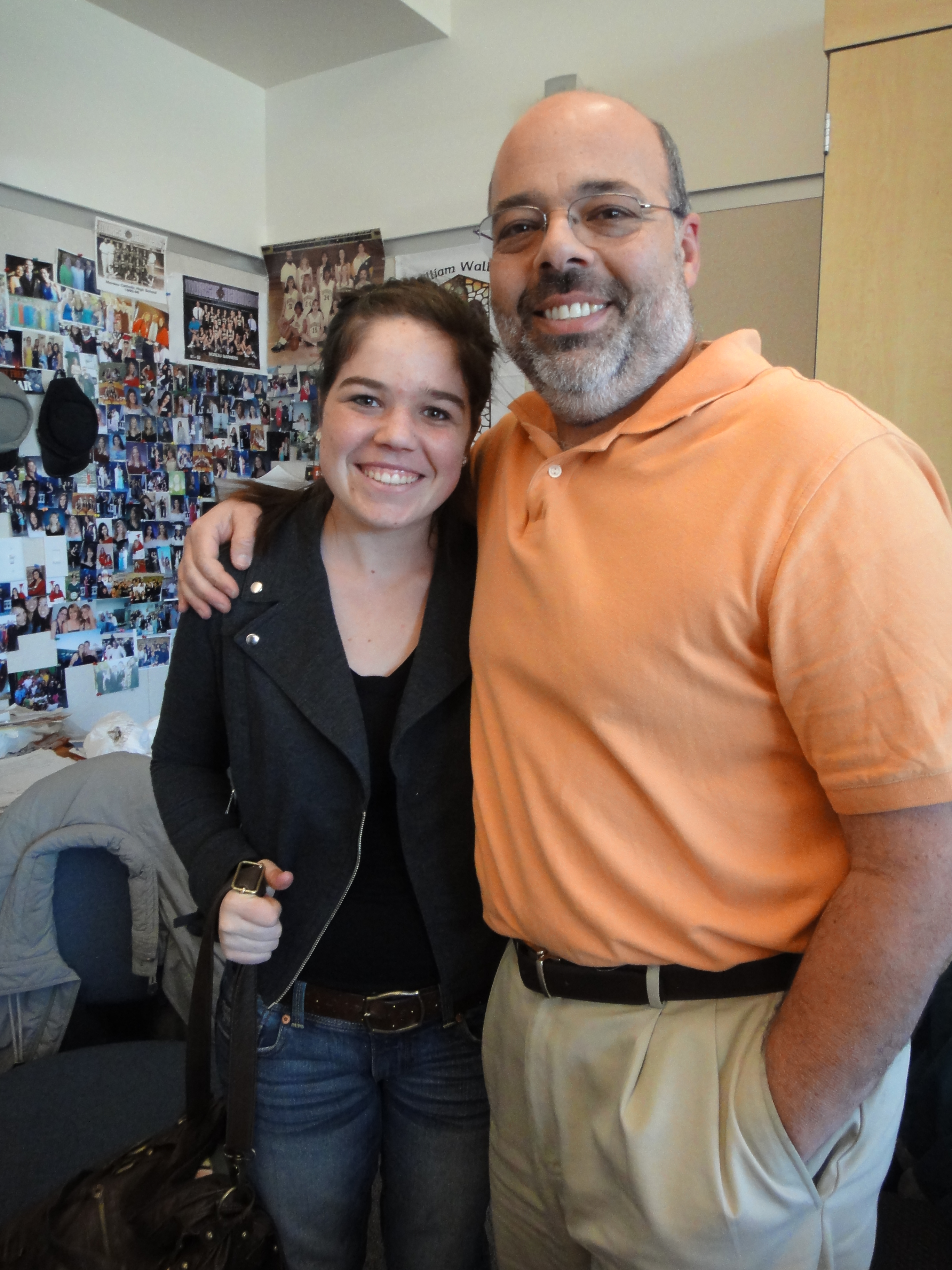
Ron Rubio with daughter Veronica
In a recent Dublin Patch article, Fallon history teacher Roberto Clemente, who had Ron Rubio as a teacher, said “I knew that someday I wanted to be ‘Mr. Rubio.’ ” One of the reasons Dublin High School history teacher Ron Rubio inspires such statements is his ability to bring history to life. Last month Mr. Rubio’s World History students met a Holocaust survivor. A couple of weeks ago US History students heard the first-hand experiences of an Oklahoma native who made the trek west from the Dust Bowl in the 1930’s and lived in migrant farm camps before ultimately becoming a professional educator and High School Assistant Principal. The use of oral histories is a tradition in Ron’s classroom and one of many techniques he uses to connect students to history.
Ron teaches AP US History, AP US Government and Politics, Civil War in America and Ethnic and Cultural Diversity in America. Next year’s course line-up will be expanded to include America in the 60’s (one of eight new courses being offered for the 2011-12 school year). Ron earned his undergraduate degree at St. Mary’s College of California (Class of ’78), his masters degree at San Francisco State University (Class of ’86), and has been a teacher at Dublin High School for over 10 years.
In this OneDublin.org video interview Ron talks about the importance of history for all students, the added challenge of Advanced Placement (AP) options and the role of parents in history education.
Shobha Tejwani: English Language Learner (ELL) Educator of the Year
by Michael Utsumi (parent)
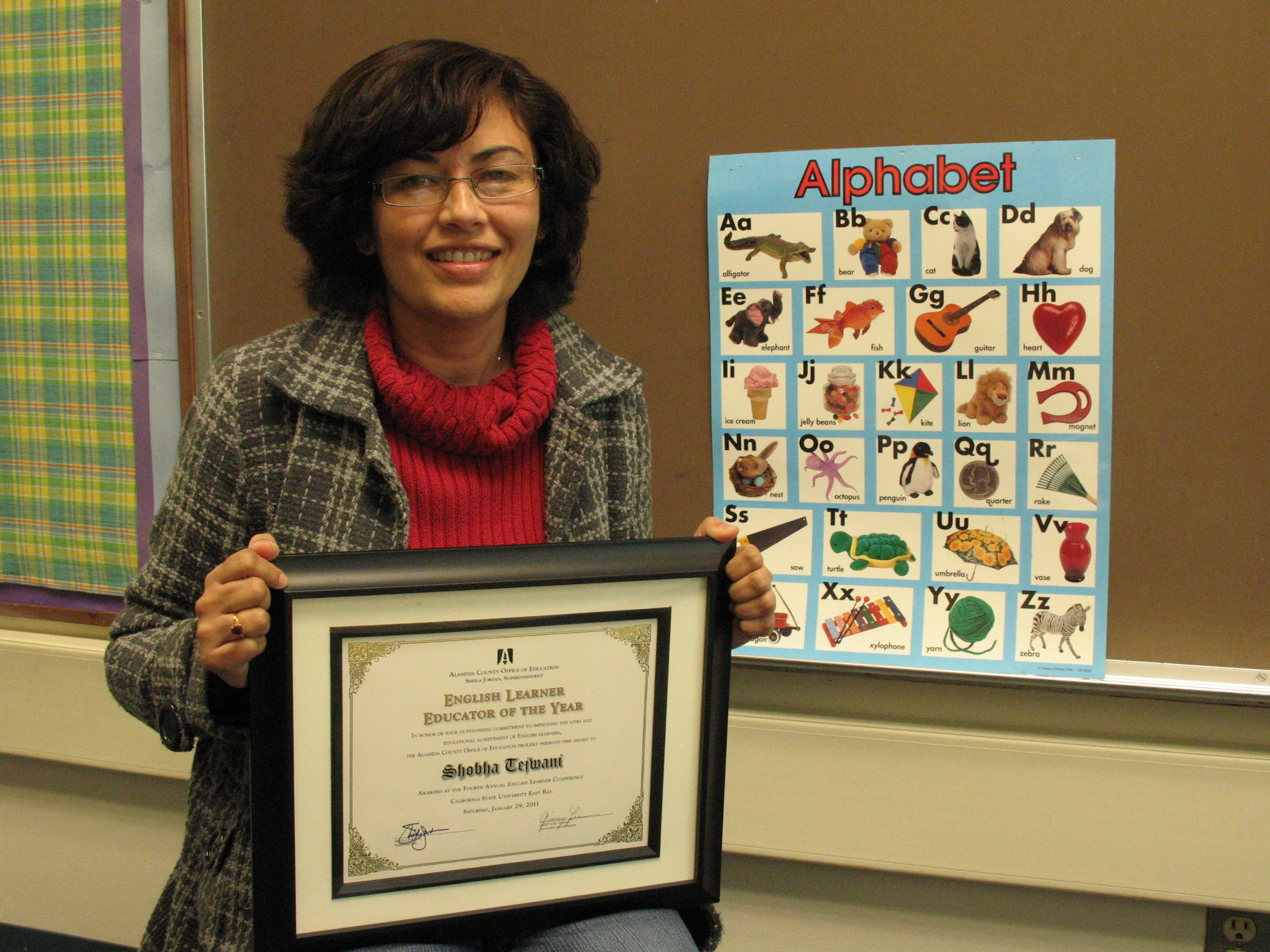
Shobha Tejwani - English Language Learner Educator of the Year
We deliver our children to their respective classrooms every day in the hopes that they will absorb their daily lessons, have the motivation to engage with their teachers and that they will complete their daily assignments. This cycle is repeated across the district and throughout the Tri-Valley on a regular basis.
But what if your child has special needs that require the skills of the school psychologist because of behavioral problems? What if English is not his native language? What if she suffers from a speech impediment? Largely, that responsibility falls to a small army of specialists working within the Dublin Unified School District.
On Saturday, January 29, Shobha Tejwani was recognized along with San Leandro teacher Elena Ball as the English Language Learner Educator of the Year by the Alameda County Board of Education. At the 2011 ceremony, held at CSU East Bay, seven individuals were honored for their current and legacy contributions to the county schools for their efforts in supporting this specific student population. Ms. Tejwani is a married mother of three boys. Respectively, they are enrolled at Chapman College, UC San Diego and Diablo Valley College. Academically, Shobha achieved her B.A. in Liberal Studies at CSU Northridge, a multi-subject curriculum certificate at CSU – East Bay and then she acquired an M.A. in Education at the same institution.
Dublin High School: College Early Acceptance Results – Class of 2011

Stanford University campus
More than 50 colleges and universities including Stanford and West Point have already said “yes” to applying Dublin High School Class of 2011 students. While the Dublin High School Class of 2011 still has several months to go before finishing high school, universities and colleges across California and the United States have sent offers of early acceptance to Dublin High students. This isn’t surprising given that 96% of 2010 Dublin High graduates reported attending college. Dublin High School’s UC admission rate for 2008-9 was 84% (read more…).
In addition to Stanford University and the United States Military Academy at West Point, here is a subset of other colleges offering early acceptance to Dublin High Class of 2011 students:
Heather Knight and Social Robotics: The Intersection of Storytelling and Technology

Heather Knight and a Robot Performer (credit: Kris Krug)
Heather Knight is a roboticist and PhD student at the Carnegie Mellon Robotics Institute who is breaking new ground in the field of “Social Robotics”. Along the way she’s earned undergraduate and graduate degrees at MIT (in Electrical Engineering and Computer Science) where she worked on Cynthia Breazeal‘s Huggable project (a new type of robotic companion being developed at the MIT Media Lab for healthcare, education, and social communication applications), founded a robot theater company (Marilyn Monrobot), worked in NASA’s Jet Propulsion Laboratory and even helped create OK Go’s award-winning YouTube sensation “This Too Shall Pass” (the Rube Goldberg machine version). [UPDATE: Heather was named to Forbes Top 30 Under 30 in the Science category: read more…]
OneDublin.org recently had the privilege of talking to Ms. Knight about the world of social robots and how her interest in technology and creative arts have intersected to create something new.
OneDublin.org: When did you first get interested in technology?
Heather Knight: My first real enrapture with technology was on a high school science team. I remember one event where you had to practice working together to build a structure using whatever materials were provided on competition day, be it marshmallows, Legos, or sticks. To make it more challenging, one team member had to create a written description of how to build the object with the materials provided, while your partner waited in another room. Your partner then had to re-create the object using just the description. It’s amazing how easy it is to miscommunicate. I always liked making things with my hands and became interested in robots later, in college.
OneDublin.org: When did you decide to pursue engineering in college and ultimately post graduate degrees?
Knight: I was trying to decide whether to become a writer or an engineer, because I always liked storytelling, I was a big reader. I didn’t really know what engineering was yet, but my dad was an engineer and he was really cool.
I took a year off during college to travel across Europe and when I came back I switched majors from mechanical to electrical engineering – exploring the world and different cultures has been such an important part of my life. Between my undergraduate and masters I worked in Paris for a robotics company for a little while, and took some acting classes just for fun. That was my first exposure to entertainment, but I realized I was really terrible at remembering lines, so now I leave the acting to my robots.
OneDublin.org: What are some of the more interesting aspects of seeing your robots in action?
Knight: One of the first things I observed is how open people are to robots – the whole room comes alive when you have this physical object on stage – people connect with robots on a plane that is very distinct from how they connect with a two dimensional computer screen. Animated machines bring the experience into the physical world.
There are many exciting applications in the world of social robots, especially where robots and people are working together. For example, in a medical situation you could have a robot that acts as a companion, helping the person feel entertained or comfortable and reminding them when to take their medicine, exercise, or just making exercise more fun. At this point the robot should not be responsible for the more serious aspects of care, but rather they act as an assistant making the job of the doctor more effective. I like the idea of people using robots to connect with other people.

Volunteerism at Frederiksen Elementary as a Way of Life
by Michael Utsumi, DUSD Parent Volunteer

Frederiksen Volunteer Louise Greer
It’s a Friday morning and thousands of Dublin Unified School District students are learning in their respective classrooms. On this January day at Frederiksen Elementary School, 25 first graders in Brenda Gundell’s room are working on various assignments or are reading. There is also an adult volunteer present. Yes, this scene is repeated in schools across the district most everyday. But this is not your ordinary volunteer. Meet octogenarian, Mrs. Louise Greer.
Louise was raised in Chicago and eventually migrated to California where she and her husband successfully raised five children. In the 1950’s, her family lived in Bakersfield. Over a ten-year period, she worked as both a Kindergarten and Pre-School teacher. “Old school” she calls it. As their children became adults with their own families and careers, the couple moved to Dublin in 2000. Unfortunately, she became a widow seven years ago. “I’ve always been an independent person and I didn’t want to stare at the same four walls – alone.” Louise said. So, four years ago, she arrived at the office of Frederiksen and simply asked “How can I help?” The staff gratefully accepted her offer and in no time she was helping in two classrooms, two days per week. Initially, she was grading papers and assisting with one-on-one reading. “I never simply tell the child the word – I want them to figure it out.” she chimed.
Louise acknowledges that the economic downturn has been partially responsible for a diminishing number of classroom volunteers. Some parents have returned to the workforce and some have been forced into longer commute cycles. At a time when education funding is at its lowest point in years, the need for volunteers may be at its highest. Though she now gets around with a rolling walker (her knees act up every so often), she faithfully makes the 1.5 mile drive to Frederiksen. “I could probably walk the distance but then I’d be too tired to help out.” she joked. She continues her in-classroom support on Fridays and then assists in the office on Tuesday mornings. She helps the staff with assorted filing and the construction of incentive coupons for the students. “Volunteering gets me out of the house and I love being with the students. All I need is for someone to say thank you.”
This profile leads us to the more global concept of volunteerism. Earlier this school year, the Frederiksen staff and School Site Council noticed an imbalance of volunteers across the site. While some classrooms had an abundance of support, other classes were lucky to have one. After the school plan was completed in December, the SSC made a conscious decision to help formalize a volunteer program that optimistically could be launched prior to the end of this school year. I recently sat down with both Principal Holly Scroggins and SSC President Michelle Florkowski to understand their ambitions on this worthwhile project.
 This Thursday, February 3, is opening night for the Dublin High Drama Club’s annual student-directed One Act Plays. Every year, the Dublin High Drama Club provides students with the unique experience of directing other students in a series of one act plays. The line-up this year includes two musical numbers.
The four performance run opens Thursday Feb 3 at 7PM in Dublin High’s Little Theatre and continues Friday and Saturday at 7pm, and closes with a 1pm matinée on Sunday Feb 6 (yes, that’s Super Bowl Sunday with a curtain time suitable for enjoying both live theatre and football).
Tickets are $7 for adults and $5 for students.
The 2011 One Acts line-up:
- The Philadelphia written by David Ives
- Electric Roses written by David Howard
- Small World written by Tracey Scott Wilson
- Heart of Hearing written by Joseph Zeccola
- “Putting it Together” from Sunday in the Park with George music and lyrics by Stephen Sondheim and book by James Lapine
- “Light” from Next to Normal book and lyrics by Brian Yorkey and music by Tom Kitt
Notes from the student directors:

Keith Nomura and the hard hat he wore during the construction of John Green Elementary School
Keith Nomura, Principal of John Green Elementary School, was attracted to Dublin nearly four years ago by the challenge of opening a new school. With a green hard hat in hand, Keith stepped onto the John Green Elementary School construction site with a dream of what the school could be and has since become. The process of opening John Green Elementary School inspired Keith to author a whitepaper, “To Dream, Imagine, and Believe: Experiences in Opening a New School”. His whitepaper provides a blueprint for other school administrators, and will be put to good use for the Dublin Unified School District’s next new school, Kolb Elementary (opening for the 2011-12 school year – read more).
In his whitepaper, Keith shares his dream of opening a new school: “My dream as a principal was to open a new school where I would be an active participant in building the culture of the school; a culture that would be built collectively by the staff and community. This would be an opportunity to be part of building a culture where I get to be an integral part of helping to build a legacy that would live far beyond my term. A place where the core values and beliefs that form the culture of the school would be a reflection of my leadership.”
OneDublin.org recently met with Keith to learn more about his philosophy as an educator, his experiences opening a new school and his unique role in the annual John Green Elementary School Gator Gallop.
Wells Middle School Leadership Team – a OneDublin.org Interview
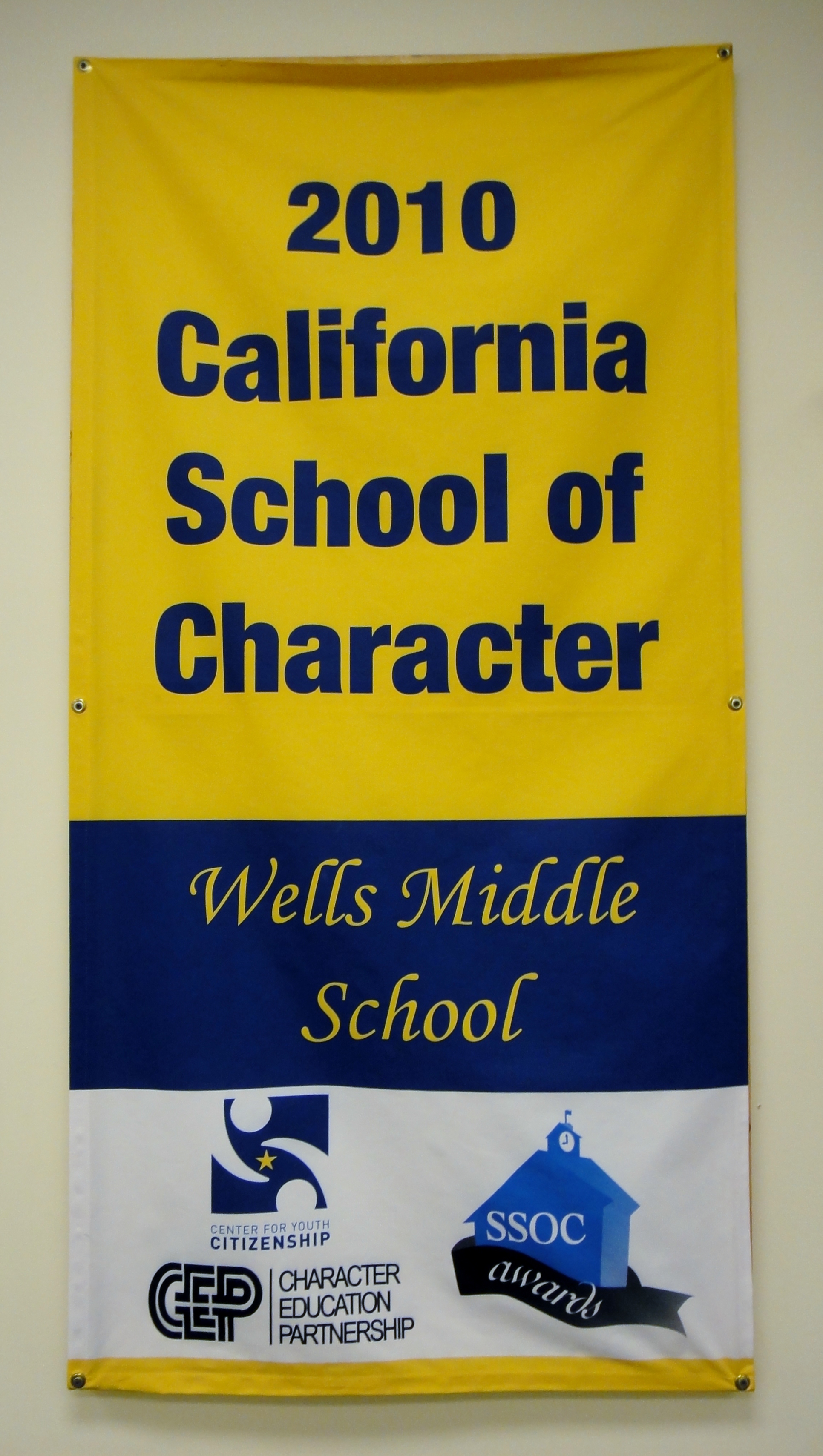 2010 was a good year for Wells Middle School – Wells achieved the highest year-over-year API growth (2009-10) of any Tri-Valley school with a 49-point increase to 838 (source). Wells Middle School was also named a California School of Character in for 2009-10, and the character education program at Wells is attributed by the leadership team as a significant factor in the API jump. Wells also benefited from Bond Measure ‘C’ with the opening of a new dining pavilion (read more…).
Wells Middle School Principal Kathy Rosselle, Assistant Principal Steve Martin and Dean of Students Mark Woy recently met with OneDublin.org to share their thoughts on what makes Wells Middle School unique, the character education program, the role of parents in education and how the Wells’ staff will insulate students from the education budget crisis.
 The DUSD School Board recently approved the addition of eight new classes at Dublin High School for the 2011-12 school year. Mandarin 1 & 2 are being added to Dublin High’s line-up of Foreign Language offerings. Dublin High’s Advanced Placement program is being expanded with the addition of AP Psychology. The Dublin High Engineering Academy, which opened for the 2010-11 school year, is being expanded to include Introduction to Engineering Design (part of the Project Lead the Way Engineering curriculum). A new, non-AP, Calculus course is being added for students interested in Calculus but not ready for the existing AP Calculus option. Social Studies expands with the addition of America in the 60’s and Culinary Arts with Baking & Pastry. Academic Decathlon, the study of major historical and cultural movements, also prepares top performing students to compete in the California Academic Decathlon.
A summary of the new 2011-12 course descriptions are available below:
 Every parent of a Dublin public school student is soon to be affected by a change in the bell schedule (the start and/or release times for students).
In order to accommodate increased collaboration time for teachers, while increasing instructional minutes for students, a mid-year bell change is going into effect on Tuesday February 22 (all elementary and high schools) and February 28 (all middle schools).
Parents should have received (or will shortly be receiving) more information directly from their school site. The bell change has two impacts:
- lengthening the school day by five minutes (by starting earlier or ending later, varying by school site)
- on one day a month ending school early to allow for teacher collaboration time
The changes being implemented February 22 will continue for the 2011-12 school year.
DUSD Superintendent Stephen Hanke published a letter on the changes (available here) where it is stated: “Collaboration, where the teachers have a structured time to work together, is research-based and is proven to have a positive benefit for students. This time allows teachers to share best practices, discuss curricular and student concerns, analyze data, work with peers from other departments, and support at-risk students. This leads to continued improved student performance through more effective delivery of instruction.”
The five collaboration days (all Wednesdays) for all Dublin public elementary and high schools are as follows. These days will be early release days (the early release time varies by school site).
- February 23, March 9, March 23, April 13, May 18
Below are links to letters sent home to parents that have also been made available online detailing changes to the bell schedule:


 OneDublin.org