The Value of Music Education from Elementary School to College and Beyond
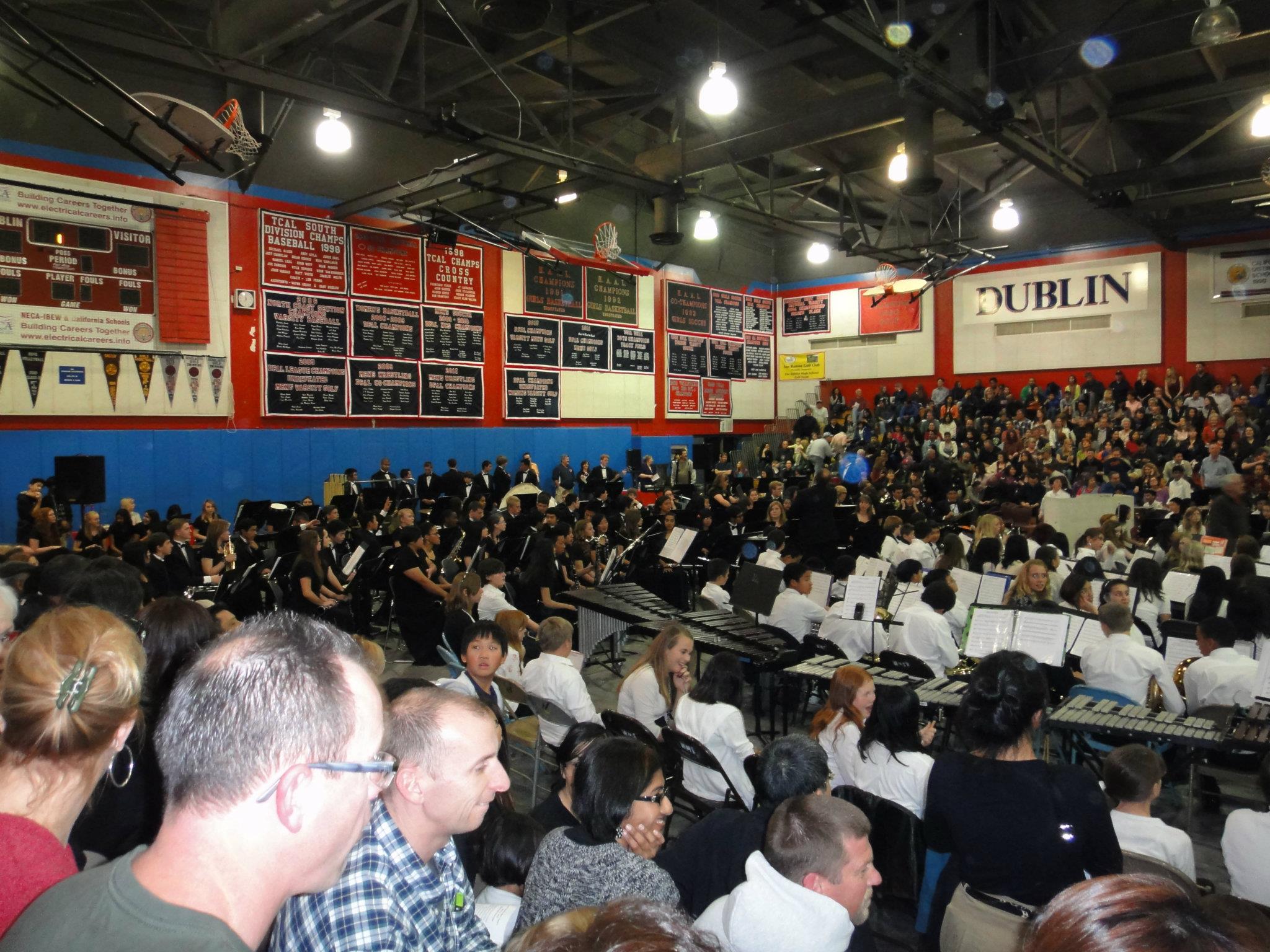
Dublin Unified School District Annual Concert 2012
With the increasing pressure to do well in high school, get accepted into college and ultimately find a job, it is tempting for some to set aside music education as not relevant, or a nice to have, or too much of a time commitment. This view is counterproductive – “The most important thing about music (or, more generally, Arts) education, which has been demonstrated by numerous studies, is its effect on non-Arts studies. The Arts teaches students how to think, how to analyze, how to study, how to practice, how to focus. Spending on the Arts is one of the most efficient uses of money, with the highest return per buck of just about any object of funding.” – Philip Morehead, Head of Music Staff, Lyric Opera of Chicago.
Musician Thomas Dolby, interviewed earlier this year by OneDublin.org, commented: “Music education has to be a big part of [the classroom]. One of the reasons that I left the U.S. and moved back to the U.K. was specifically that. I got so upset with the cuts that were taking place in Californian schools, the schools my kids were in, and the last straw was when our school took away the music program. In fact the last year I was there, a group of parents and I had to raise money independently just to keep one teacher on, to teach music in the schools. That was just driving me nuts. I wish music was built into our concept of how education should be going forward.”
According to a Harris Interactive poll of school principals, music programs contribute to higher attendance and graduation rates and The College Board reported in 2011 that SAT takers with coursework / experience in music performance scored 120 points higher on the verbal portion of the test (reading + writing) and 44 points higher on the math portion than students with no coursework or experience in the arts. SAT scores for those with coursework in music appreciation were 129 points higher on the verbal (reading + writing) and 43 points higher on the math portion.
Finally, the benefits of music education aren’t just for those planning to pursue music in college or as a career. In fact, 95% of the University of Minnesota’s Marching Band are not music majors.
To go beyond the stats, we reached out to current and former members of the University of Minnesota’s band program for their thoughts on how music has been a positive influence on their lives:
Ryan G, E.I.T. ., B.C.E. Structures Emphasis, University of Minnesota:
“I am a recent graduate from the University of Minnesota – Twin Cities with a Bachelor’s Degree in Civil Engineering. I was also a four-year member of the University of Minnesota Marching Band or ‘Pride of Minnesota.’ A lot of people view music and the arts as an ancillary item in a person’s education; however, music has been an important player in my life for as long as I can remember. The examples that I draw from are based on my high school and college education.
“In high school I was involved in both band and choir, including marching band. These activities were a great way for me to hone my craft. During my senior year, however, I faced a difficult decision: whether or not to take Physics, which only occurred during either the band or choir time slots. Since I was planning on enrolling in a science-based major in college, I elected to take Physics. In order to be active in choir, which I replaced with Physics, I also dropped my study hall and enrolled in our high school’s music theory course. This was possibly one of the best decisions that I made in high school. Although I was not in the actual choir, I was able to learn the parts in Music Theory and participate in that manner. This allowed me to not only take Physics, but also to hone my ability to quickly work up new songs or parts.
“When I went to college, I was told that being in the marching band would be difficult with a science or engineering major. This was true, but participating in band was also the single best decision I have made in my entire college career. Marching band helped me in three ways: I instantly had over three hundred friends who wanted to see me succeed, the stress that I felt in my major was easier to manage in the fall semesters when I had the two to three-hour diversion from my course-load, and finally, the time management skills that I gained while juggling homework, classes, and band will be beneficial throughout my entire life.
“In conclusion, I know that my life could have been much easier had I not been so thoroughly involved in the Arts, especially music. However, the positive impacts that I have experienced by being involved in band so thoroughly outstrip the negatives that I can say without any hesitation that it is worth the time and effort, even at the expense of choices that could have set me up better for my future as an engineer.”
Clara M., University of Minnesota Marching Band Color Guard
“Why stay in band?
- Band provides camaraderie. I met most of my high school friends in band, and the people in my college marching band are fantastic.
- Band is cool in college. I can’t tell you how many times people have said to me, “You’re in the marching band? That’s so awesome. I wish I had stayed in music back in middle school so I could do that.”
- Band is a learning experience. Marching for the University of Minnesota was one of the hardest things I have done, but also one of the most rewarding.
- There’s a lot of pride that goes along with being in the band. Not only do people all over campus recognize you, but so do people throughout the community and you feel really good about what you do. I’m extremely proud to be a part of the Pride of Minnesota, and it’s helped me get more involved in my school in general. There’s this fantastic feeling that comes with getting out on the field in front of several thousand people to perform a show that you know is good and that you’re really proud to be a part of.
- College band is just super fun.It’s not just marching band, but also the concert bands that any student can join and the concerts you can attend. I had a great time in marching band, but I also loved being in concert band during the spring semester.
- Band is something you can do for the rest of your life, no matter your profession. Some research has shown that being in music makes you better at a lot of other topics. For me, music can be a way to relax. There is so much of a push today to make sure students like you are ready for a career. That is undeniably important, but at the same time, you have your whole lives to develop that career. Life isn’t just about where you work. It’s about doing things that make you happy. Band might not be “cool” or “important” right now, but I can just about guarantee that if you stick with it a little longer it’ll be pretty darn awesome.”
Lindsay B., University of Minnesota
“I am in the Color Guard at the University of Minnesota Marching band and I will be entering into my fourth year of college, as well as fourth year with this band in the fall. Amongst all the major coursework I have for my BA in Pre-Law, I make it a priority to leave enough time in my schedule for Marching Band. This band makes me feel like I am a part of this university in a way no other student activity can. Marching Band is considered a class, but I don’t think of it that way. The band it’s something I love to do; it keeps me motivated both academically and mentally. It has taught me so many life lessons that sitting in a lecture hall could never teach me. I have gained lifelong friends, determination, and adaptability just to name a few. Band is a major part of my like and has always been a highlight of every school year, including my high school years, and I couldn’t even imagine how boring my life would be without it.”
Joseph T., University of Minnesota, Tuba Player & Civil Engineering Major
“I am a civil engineering student at the University of Minnesota and a tuba player there. Why students should continue in music is a question that has too many right answers for one email, so let me settle on the less obvious reasons.
“First: You may never get a chance to play music again. Formally you may never get to pick up the trumpet, never have friends counting on you for that. Music is important and it’s fun, and if you ever stop it’s a lot harder to get back on the bandwagon (just think how hard it is when Fall comes and you haven’t really practiced all summer).
“Second: You will never have certain opportunities without music. Unlike many clubs on campus, which tend to draw from the same disciplines (only civil engineers try out for concrete canoe), the Pride of Minnesota Marching Band draws members from every discipline. By having such a large and tight-knit organization I can count among some of my closest friends people who think about problems in very different ways. I have friends in music education, engineering, social sciences, history, nursing, pre-med, pre-law, communications, management and even a few who have no idea what direction they wish to take, because the marching band is a home for everyone. By knowing, interacting, working and problem solving with all these people who think in different ways I know that I have done better in my classes, have more confidence and have a group of friends who were willing to stand up for me.
“Third: Do you know how hard it can be to get a decent letter of recommendation? For an internship or student job you need at least one by a professor who knows you well. My professors know who I am and that I work hard, but the only one I trust to write a recommendation that shows they know me, that shows that this was not a form letter, that shows that I know what I’m doing and will work hard, is the director of the marching band. It is one of the first things he offers and I cannot thank him enough just for being on my resume as a reference. There are sayings ‘it’s not what you know but who’ or ‘you will think of people what you wish to think of them’, and if you get a glowing, personalized letter of recommendation from a person who is seen in high regard, your application jumps up to the top of the stack, it is equal to a sizable GPA boost (on top of the boost you already get by being a member of the band). There is no doubt in my mind that putting the director the Pride of Minnesota Marching Band on my resume has already gotten me jobs and already gotten me interviews and volunteer opportunities I wouldn’t have had access to otherwise.
“If you are questioning what is best for you for future employment, let me just say, music and the arts are what you need, you need a strong repertoire of dealing with people different from yourself and it will help you more when it matters than any other high school class ever would. I cannot thank my band teachers enough and I still have 2 or 3 years left to go.”
Jacquelyn R., University of Minnesota
“I’m in my third year at the University of Minnesota studying Business Marketing Education with a triple minor in Leadership, Psychology, and Adult Education. I have made the dean’s list with a 3.94 GPA for the last two semesters, have a full-time sales internship with the 10th largest private company in the world, and work a 20-hour / week job for the university during the school year. I am an officer in a co-ed music service fraternity, have a large group of friends (both in an out of band), have been dating the same great guy for four and a half years, and am able to see my 30-minutes-away-family several times a month.
“It sounds like a personal commercial, but what I’m trying to say is that your life is as full as you make it. People thrive in all kinds of different ways, and I thrive under hard work. But what college has taught me most of all is that the human soul, the most untouchable part of you, has to be nurtured in order for anything else to thrive. If you have music in you, you know. It’s in your blood and bones. And if you think that you’ll be healthier or wealthier or better off if you focus on your major, career, social life, or grades, you’re wrong. Those are all important – but if music is part of you, if the four right chords can make you cry and if music has given you anything, college is the time to give back. You will grow and learn and meet opportunities both academic and social, but everything goes back to music. It all goes back. You can’t run on empty, and you can’t grow from anywhere but your roots; being part of something bigger than yourself, giving back, and doing what matters to your soul is what college is for.”
Emily B., University of Minnesota
“Why stay in music? Why do marching band? Why the heck do you have a french horn tattooed on your foot? These questions are often followed by my description of my college education choices. I am an Anthropology Major, a French Minor and a Music Performance Minor on the French Horn and I do marching band. A better question would be to ask me can you imagine your life without music. And I can’t. I play music so I can breathe. Music is the place I go that nobody else can interfere. It is my own personal world. The world that I know I can succeed in. Using someone else’s words “music is the international language, everybody can understand it.” I fully believe that. Music is an individual effort along with group effort. Your part never seems unimportant, it is always important. Each individual has a specific part to play that without it the whole would collapse upon itself.
“Once you accomplish something so monumental like putting on a concert or a halftime show, you can’t imagine doing it any other way. And the people who you perform with, you learn to understand them to their very depths, probably even better than they know themselves.
“That’s why I do music. To get a deeper understanding of myself and of my friends through music. Through music I soar.”
Fortunately for Dublin residents, the Arts has remained a priority in Dublin’s public schools at all levels. This summer will also see construction start on the new Dublin High School Performing Arts Centre, funded by voter-approved Bond Measure ‘C’. The new facility will significantly expand the performing space available Dublin High students and the community.
Trackbacks
Comments are closed.


 OneDublin.org
Larry – I love your passion.
The article’s focus is meant to show there is music past middle school – onto high school – onto college. The article is meant to give the students a sense there is life beyond high school AND THERE ARE SCHOLARSHIP MONIES AVAILABLE TO BE IN MUSIC (in this case marching band) – even for NON-MUSIC MAJORS. The article is not meant to be “pro marching band.” It is meant to be PRO MUSIC EDUCATION and for many of us marching band is PART PART of music education. I sent fifty university marching bands “cries for help.” The letters the article quoted are from emails I received. I am very motivated by what the college/university students are saying!!
I do get your point, Larry.
Psalm 56:
Well thank you. Yes you are correct there is music beyond high school & college for that matter. A lot of the problem is that once kids are past high school and the MB experience they put their horns in the case and never take them out.
Yes I know about the scholarships. I prepared 1 of my clarinet students for a competitive audition for a scholarship. He won a renewable $14K music scholarship + a $16K academic scholarship. He never worked so hard on his horn in his life. I asked him how serious he was. He said he really needed this to help his family out I told him he needed to do exactly what I say and that he would probably feel like I was kicking him in the butt. But he did the work, played the audition and was 1 of 4 selected to play in the clarinet section on scholarship money.
If schools today would put 1/2 the focus on creativity, ie jazz improv that would help. Because jazz improv and learning how to think on your feet in a combo are skills that can be used post high school/college. You ought to read some of Jamey Aebersold’s thoughts on this subject. One of the problems w/MB is that there isn’t any creativity on the part of the performer. It’s kind of like you are a drone.
To really function in music post high school/college even if it’s just for fun being able to sight read is very important, even if you don’t play jazz. Having a really good sound/tone is on the top of the list, then technique, next is knowing how to play different styles. Then for the guys interested in jazz it’s knowing tunes & how to interrupt them, jazz improv and also knowing how to play in a section, although big band’s in the real world are going away. Still if you get into doing shows, playing studio dates etc it’s important. Also LISTENING is VERY IMPORTANT. To many kids do not know who to listen to.
Fyi – I have played in MB’s. In the Navy and the Army we did it. But % wise in the Navy it was a small part of the gig. We usually stood or sat while playing ceremonies. We did get roped into doing those %$@#* Tattoo’s. I have done 14 of those things, that’s 13 to many. I was even ordered to be the Saxophone Soloist in the 1999 Scope International Tattoo. Notice I said ordered, I didn’t volunteer for it. We even went up to Halifax, NS and did the really Big Show/Tattoo up there. Yes I did meet some nice people from some of the other groups, both bands and non band groups. But the gig was BORING. I had my fun during our off duty hours. That’s 1 good thing about the Navy Band. Once we have a show/concert down that’s it, we don’t rehearse it to death. The poor band from the Netherlands was out there drilling and over rehearsing, poor guys. Meanwhile our band, the Royal Brit Marines, the Canadian guys, the Estonians were out having fun during our off hours. Oh yeah the bloody Tattoo went from 7 – 11 pm on the dot. Lastly the French Forgein Legion Band got smaller every day. Their band had a lot of ex-Soviet Bandsmen in it and they were going over the hill. A bandsmen from the military in Canada said they picked the right country to go over the hill. He said the govt would give them bloody social welfare while they were looking for work in Canada.
Talk to you later Psalm 56.
Wow, Larry, I see why you like jazz so much-you take a couple of words from a comment and use them to go on rambling tangents. Or you just like to see your words in print.
This article has struck a nerve (with over 1,000 Facebook ‘Likes’) and for those interested in this topic I also recommend you read the OneDublin.org interview with musician Thomas Dolby from earlier this year (https://onedublin.org/2012/04/14/thomas-dolby-on-music-education-and-the-evolution-of-the-music-industry/). The point of this article was to put a spotlight on the many benefits of music participation for future musicians and those pursuing careers other than music.
Phyllis:
Yes I do love Jazz. I do tend to be verbose but I am only trying to make a point. It has nothing to do with ego etc.
Over 2,300 “FACEBOOK LIKES!!” = awesome. WE need articles like this one to “balance” an article like this… http://www.latimes.com/news/local/la-me-lopez-lausd-20120606,0,5560153.column
Cuts like these are being seen in Chicago and I am sorry to say probably many other metropolitan areas. Something that has been a part of American culture since the 1830s (LOWELL MASON – Father of Music Education) is seriously in jeopardy of leaving public education. Sad to see that music is going to possibly be for the “select” few. KEEP MUSIC ALIVE FOR ALL!